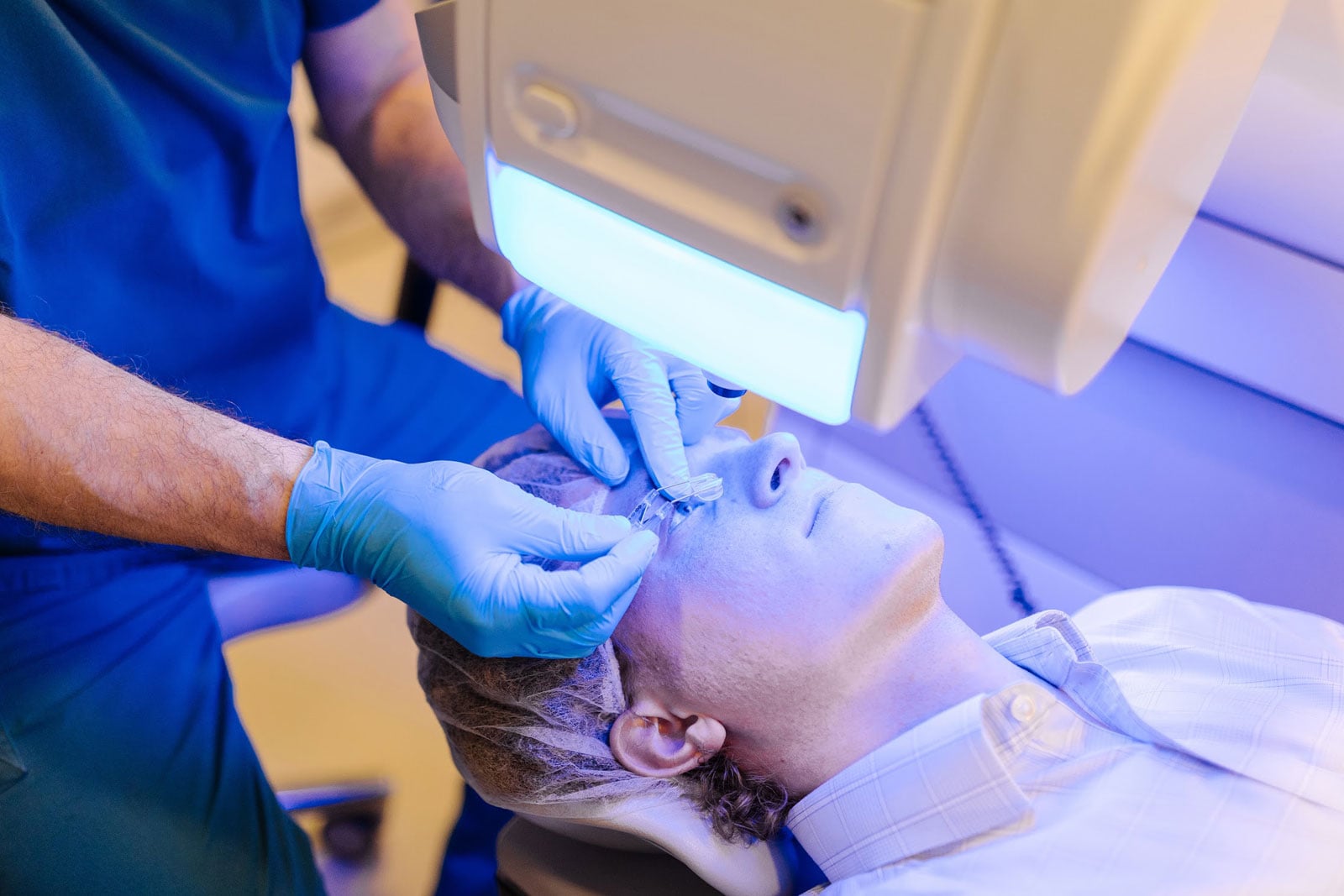
Thanks to advancements in expertise and technology in recent years, more people than ever before are now suitable for Laser Eye Surgery. However, there are some factors that may affect your eligibility for treatment. On this page, we’ll be taking a look at some of the most common questions regarding conditions that may make you unsuitable for Laser Eye Surgery.
Can I Have Laser Eye Surgery If I Have Diabetes?
Diabetes is a condition that affects blood sugar levels. It can also impact other parts of the body, including the eyes. Some people who have diabetes may also develop diabetic retinopathy which affects blood vessels in the eye. In some cases, this may be a contraindication that could make you unsuitable for treatment.
Your suitability for Laser Eye Surgery will also largely depend on whether your condition is effectively controlled. While having diabetes does not, in itself mean that you won’t be suitable for treatment, this will be assessed on a case-by-case basis at your initial screening.
For more information and a video on this topic, click here.
Can I Have Laser Eye Surgery If I Have Systemic Lupus Erythematosus?
Systemic Lupus Erythematosus (SLE) is an inflammatory autoimmune disease in which the body’s immune system attacks its own tissues. It is the most common type of lupus. Both the condition and treatment drugs may cause ocular effects, however, this does not necessarily make you unsuitable for Laser Eye Surgery.
For more information and a video on this topic, click here.
Can Laser Eye Surgery Treat Amblyopia (Lazy Eye)?
Amblyopia, more commonly known as ‘lazy eye’, occurs when the vision is one eye is not fully developed. Amblyopia usually develops in childhood and should be treated as soon as possible. Therefore, the condition cannot be treated with Laser Eye Surgery.
Patients with amblyopia may still be eligible for Laser Eye Surgery to correct their refractive error. However, treatment will only be able to refine vision in the amblyopic eye to the same extent as glasses. Many patients with amblyopia have had successful outcomes after Laser Eye Surgery.
For more information and a video on this topic, click here.
Can Laser Eye Surgery Treat Strabismus (Squint)?
Strabismus, or ‘squint’ is not generally a contraindication for Laser Eye Surgery, however, there are some considerations that should be made. For example, if your strabismus is caused by amblyopia, as noted above, Laser Eye Surgery will not be able to correct your vision beyond the ability of glasses.
Nonetheless, while Laser Eye Surgery won’t reduce the appearance of a squint, it can still provide satisfactory outcomes for many patients. Your suitability for treatment will be assessed on a case-by-case basis based on a wide range of factors.
For more information and a video on this topic, click here.
Can Laser Eye Surgery Treat Astigmatism?
Astigmatism is a common refractive error that refers to an abnormally shaped cornea. While a healthy cornea is spherical in shape – like a football – in astigmatic patients, the cornea is shaped more like a rugby ball.
Laser Eye Surgery can be extremely effective at correcting this error, leaving many patients with satisfactorily improved vision. However, your suitability for Laser Eye Surgery may depend on the extent of your prescription and the treatment capabilities at your chosen clinic.
For more information and a video on this topic, click here.
Can I Have Laser Eye Surgery If I Have HIV?
Human Immunodeficiency Virus (HIV) is a virus that attacks the body’s immune system. In some cases, the disease may be associated with a higher risk of eye conditions such as Cytomegalovirus (CMV) retinitis, which manifests as blurred or lost central vision, and Herpes zoster.
However, having HIV will likely not mean you are unsuitable for Laser Eye Surgery. You should indicate your HIV status at your initial screening when your suitability for treatment will be determined.
For more information and a video on this topic, click here.
Can I Have Laser Eye Surgery If I Have a Compromised Immune System?
A number of conditions can compromise your immune system. In some cases, this can mean that your body takes longer to heal. When it comes to Laser Eye Surgery, this may put you at a higher risk of experiencing complications.
However, having a compromised immune system doesn’t necessarily mean you will be unsuitable for treatment. You should indicate this at your initial screening so your doctor can take this into account when assessing your suitability.
Can I Have Laser Eye Surgery If I Have A Collagen Vascular Disease/Connective Tissue Disease?
Collagen vascular disease is a group of conditions that cause chronic inflammation of the connective tissues. This includes autoimmune diseases such as lupus, ankylosing spondylitis, rheumatoid arthritis, scleroderma, Sjögren syndrome, and temporal arteritis, as well as Ehlers-Danlow syndrome, Marfan syndrome, and osteogenesis imperfect. Such conditions may also be known as connective tissue diseases.
Current evidence suggests that patients with a well-controlled collagen vascular disease can achieve good results with Laser Eye Surgery. Your suitability for treatment will be determined based on your overall health and control of the condition.
For more information and a video on this topic, click here.
Can I Have Laser Eye Surgery If I’m Taking Prescription Drugs?
Generally speaking, the use of prescription medications will often not make you unsuitable for Laser Eye Surgery. Most prescription drugs will not interfere with your treatment or recovery; however, this is not the case for all medications.
It is, therefore, important that you make us aware if you are taking any prescription drugs during your initial screening so we can consider this when determining your suitability.
For more information and a video on this topic, click here.
Can I Have Laser Eye Surgery If I Have Glaucoma?
Glaucoma is a relatively common eye condition, the risk of which increases with age. While the condition itself is not necessarily a contraindication for Laser Eye Surgery, your surgeon will take into account other factors relating to your glaucoma, including intraocular eye pressure.
Furthermore, as glaucoma can continue to affect your vision, even after Laser Eye Surgery treatment, your surgeon will discuss with you the benefits you can expect to achieve before you go ahead with treatment.
For more information on this topic, click here.
Can I Have Laser Eye Surgery If I Have Epilepsy?
You may assume that having epilepsy will make you unsuitable for Laser Eye Surgery, but generally, this isn’t the case. Many patients with epilepsy have achieved good outcomes with Laser Eye Surgery.
The laser used during treatment does not emit strobe lighting. Nonetheless, your surgeon may discuss your treatment with your clinician to ensure Laser Eye Surgery will not increase your risk of experiencing a surgeon. In some cases, it may only be advisable to have treatment if you have been seizure-free for 12 months.
For more information and a video on this topic, click here.
Can I Have Laser Eye Surgery If I Have Thin Corneas?
For a long time, having thin corneas meant that you would be unsuitable for Laser Eye Surgery. However, this may not be the case anymore. New techniques and technology mean that more people – including those with thinner corneas – are now suitable for treatment.
Even if you have been turned down by another clinic due to the thickness of your corneas, we may be able to help.
For more information and a video on this topic, click here.
Can I Have Laser Eye Surgery If I Have Nystagmus (Involuntary Eye Movements)?
Nystagmus can be physiological or pathological, but no matter what causes your involuntary eye movements, it is likely that you will still be suitable for Laser Eye Surgery. Furthermore, with correction of the refractive error, some patients may experience a reduction in associated symptoms, though Laser Eye Surgery cannot treat nystagmus.
For more information and a video on this topic, click here.
Can I Have Laser Eye Surgery If I have, or have had, Herpes Infection of the Eye?
A history of herpes eye infection (herpes simplex keratitis) is not a contraindication for Laser Eye Surgery in cases without multiple reoccurrences. However, it is necessary for patients to have had no evidence of disease for at least 12 months prior to treatment.
This will be assessed in more detail during your initial screening.
Can I Have Laser Eye Surgery If I Have Keratoconus?
Keratoconus is a genetic eye condition that causes the cornea to become progressively thinner and increasingly bulge out in the centre. The associated astigmatism can cause significant vision impairment.
As Laser Eye Surgery involves removing an area of the cornea, the procedure is not suitable for patients with keratoconus. However, at London Vision Clinic, we are able to successfully stabilise keratoconus with a treatment called cross-linking.
For more information and a video on this topic, click here.
Can I Have Laser Eye Surgery If I Have A Cataract?
Cataracts occur when the proteins in the eye’s lens break down and clump together, forming an obstruction. They become increasingly common as we age and affect almost everyone at some point in their lives.
Laser Eye Surgery cannot treat cataracts (only Cataract Surgery can do this); however, having cataracts will not necessarily prevent you from having Laser Eye Surgery. Patients in the very early stages of cataract may still be suitable for laser treatment; however, this is determined on a case-by-case basis.
For more information and a video on this topic, click here.
Can I Have Laser Eye Surgery If I Am Prone To Keloid Scarring?
Keloid scars are raised areas of scarring that develop after a wound has healed. While this type of scar can occur anywhere on the body, they are most common on the chest, shoulders, chin, neck, lower legs, and ears.
Keloid scarring is linked to an overproduction of collagen in the skin; however, this has been found to have no influence on Laser Eye Surgery results. Therefore, being prone to keloid scarring will not usually mean you will be unsuitable for Laser Eye Surgery treatment.
For more information and a video on this topic, click here.
Can I Have Laser Eye Surgery If I Have Iritis?
Iritis refers to inflammation affecting the iris – the coloured part of the eye. This inflammation can occur for a number of reasons, including eye injuries, infections, and as a result of autoimmune diseases. In many cases, it is not possible to determine the cause of iritis.
As the cause is often unknown, it is not advisable to have Laser Eye Surgery if you currently have, or are recovering from iritis. You will likely only be deemed suitable for treatment if there hasn’t been a reoccurrence of the inflammation in the 12 months preceding your surgery day.
For more information and a video on this topic, click here.
Can I Have Laser Eye Surgery If I Have A Detached Retina?
A detached retina, or retinal detachment, occurs when the retina – the light-sensitive layer at the back of the eye – is pulled away from its normal position. This can occur for a number of reasons and can cause the occurrence of new “floaters“, flashes of light, and dark shadows in your peripheral vision.
Laser Eye Surgery is not a treatment for retinal detachment, however, once the issue is addressed with the correct medical care, many patients are once again suitable for Laser Eye Surgery treatment.
For more information and a video on this topic, click here.
Can I Have Laser Eye Surgery If I Have Macular Degeneration?
Macular degeneration is a genetic condition that affects the macula – the central part of the retina – at the back of the eye. There are two main types of macular degeneration: “early” or “dry”, and “exudative” or “wet”. Both forms typically affect the finer details of vision, both up close and at a distance.
Patients with macular degeneration may still be suitable for Laser Eye Surgery treatment; however, the procedure is not able to treat the condition. Furthermore, other treatment options cannot reverse the effects of macular degeneration on your vision, so Laser Eye Surgery will only be able to provide the same level of improvement as glasses. Your doctor will discuss
For more information and a video on this topic, click here.
Can I Have Laser Eye Surgery If I Have Prism?
If you have strabismus, or squint, (see section above), you may be familiar with prisms. Prisms are optical elements that are added to glasses to account for double vision and enhance visual comfort for people with strabismus.
As mentioned above, patients with strabismus may still be suitable for Laser Eye Surgery; however, it may still be necessary to wear prism glasses after your treatment.
For more information and a video on this topic, click here.
Can I Have Laser Eye Surgery If I Have Dry Eyes?
Our eyes require constant lubrication in order to remain healthy and functional. Having said that, the occasional bout of dry eyes is not common – especially for those who use screens for a living. However, for some people, dry eye can be a significant burden.
Patients with pre-operative dry eye will go through extensive review in our clinic to evaluate the cause and severity of their eye dryness. If the issue is treatable, it is possible that you will be able to move forward with Laser Eye Surgery – but this isn’t always the case.
For more information and a video on this topic, click here.
Can I Have Laser Eye Surgery If I Have Large Pupils?
While having large pupils isn’t an eye condition, in the past, it has affected people’s suitability for Laser Eye Surgery. This is because older technology was unable to cater to the larger treatment area presented in patients with larger pupils.
However, with our custom-programmed treatments, we can now successfully treat patients with very large pupils, without inducing night vision disturbances (which would have previously disqualified patients with very large pupils).
For more information and a video on this topic, click here.
Can I Have Laser Eye Surgery If I Have Night Vision Disturbances?
‘Night vision disturbances’ can refer to a number of visual disturbances that occur at night or in low light conditions. This includes glare from light sources such as headlights or street lights, as well as halos are starbursts. They may be linked to a number of refractive or health conditions or vitamin deficiencies.
Having night vision disturbances will not, in itself, exempt you from having Laser Eye Surgery. Depending on the cause of the issue, you can still have treatment – and you may even notice an improvement in your night vision!
For more information and a video on this topic, click here.
Can I Have Laser Eye Surgery If I Have Only One Good Eye?
Yes. Laser eye Surgery is performed on each eye separately to account for differences in prescription. It is therefore possible to have Laser Eye Surgery if you have one good eye or only require treatment on one eye.
For more information and a video on this topic, click here.
Other factors that can affect your suitability for Laser Eye Surgery include age (only suitable for over 18s), and being pregnant or breastfeeding. However, these are temporary barriers so you may well be suitable for treatment at a different time.
Still have questions about your suitability for Laser Eye Surgery? Don’t hesitate to get in touch or Book a Consultation today to learn more.