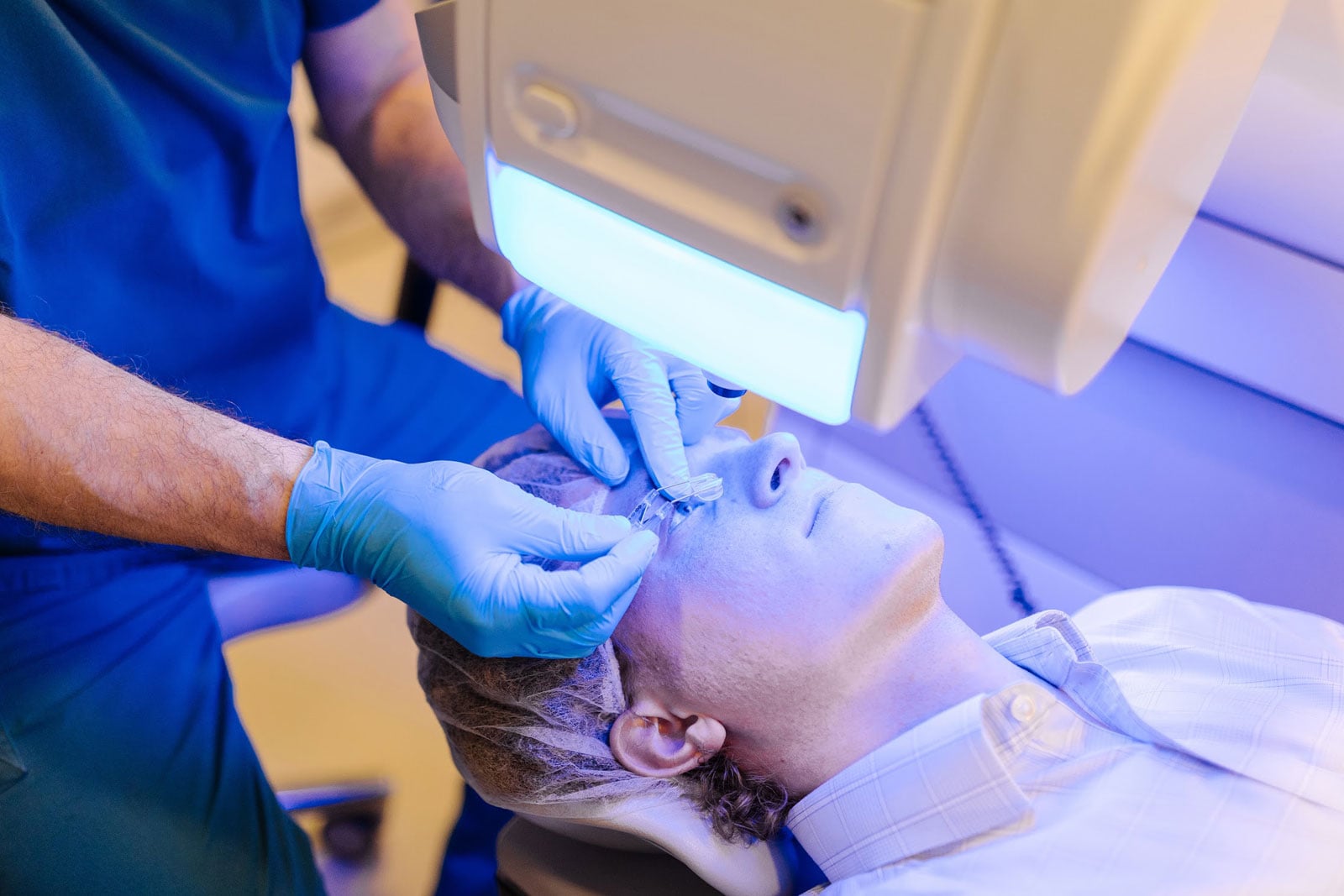
Laser Eye Surgery has become an extremely popular elective procedure – the most popular in the world, in fact. But many people are still unaware that Laser Eye Surgery could be the perfect option for them.
Nowadays, Laser Eye Surgery can effectively treat high prescriptions and a wide range of refractive errors, including astigmatism, presbyopia, myopia, and hyperopia.
What is Hyperopia?
Hyperopia – known more commonly as long-sightedness or far-sightedness – is one of the four most common refractive errors. It occurs when the shape of the cornea causes light to be focused abnormally onto the retina at the back of the eye. For example, if you have long-sightedness, your cornea is shorter and flatter than it needs to be.
This means that, rather than light being focused on the retina, it is focused on a point just behind it. As a result, long-sighted people tend to see fine at a distance (at least at first) but struggle to make out objects that are closer up.
In the video below, Mr Glenn Carp explains: what is hyperopia (long-sightedness).
Hyperopia is a common refractive error that is estimated to affect around one in four of us. In most cases, it is a lifelong error which is often inherited. Most babies are born with hyperopia to some extent but this usually corrects itself as we get older. However, when hyperopia remains, it tends to worsen as we age and may also be associated with an eventual reduction in distance vision.
Hyperopia can also develop over time. Unfortunately, this means that even people who have enjoyed great vision for their whole lives may eventually find that they need glasses to read and perform close work.
How Does Laser Eye Surgery Treat Hyperopia?
Laser Eye Surgery works by changing the shape of the cornea, and hence the way light is refracted into the eye. In the case of hyperopic, or long-sighted, patients, surgeons are able to correct the shape of the cornea to ensure light no longer focuses on a point behind the retina.
There are several types of Laser Eye Surgery that can be used to treat hyperopia: LASEK/PRK, LASIK, and ReLEx SMILE.
While all of these procedures are slightly different, they maintain the same technique to correct hyperopia (and other refractive errors). Each procedure involves the surgeon removing tissue from the corneal bed (behind the corneal epithelium) using a high-precision laser. This tissue is drawn out of the eye, changing the shape of the cornea.
In the video below, Mr Glenn Carp explains how Laser Eye Surgery can help with hyperopia.
Laser Eye Surgery for hyperopia (long-sightedness) corrects the refractive error, improving the patient’s near vision. In most cases, this means that patients can finally say “goodbye” to a life of glasses and/or contact lenses! However, as Mr Carp explains in the video above, patients over a certain age may also have presbyopia to contend with. If this is the case, they may also benefit from PRESBYOND® Laser Blended Vision.
Alternative Treatment Options for Hyperopia
While Laser Eye Surgery is an extremely safe and effective treatment option for hyperopia, it may not always be the best option. There are a number of factors that can affect a person’s suitability for Laser Eye Surgery, including their prescription, dry eyes, and overall health of the eyes. Some conditions, such as diabetes and high blood pressure, may also render a patient unsuitable for treatment.
In these cases, alternative treatments may be considered. One such alternative treatment is intraocular lenses.
Intraocular lenses are artificial lenses that are surgically implanted inside the eye, just behind the pupil. These lenses may be referred to based on the type of lens used. For example, IOLs, phakic IOLs, implantable lenses, clear lens extraction or exchange (CLE), intra-corneal lens implants, Artisan® lenses, Prelex® lenses, RLR or lens replacement surgery can all be used in this context.
In the video below, Mr Glenn Carp explains how intraocular lenses work as an alternative to Laser Eye Surgery for hyperopic patients.
While some patients may be unsuitable for Laser Eye Surgery, advancements in the field mean we are now able to treat more patients than ever before. In fact, at London Vision Clinic, we are able to treat around 98% of patients that come to us. With access to world-renowned surgeons and the most up-to-date state-of-the-art technology, our results speak for themselves.
Laser Eye Surgery for hyperopia not only means no more glasses, fiddly contact lenses and headaches from straining your eyes, but it can also make an enormous difference to everyday life. Millions of people have now discovered how everything from their morning showers to sports and playing with their children has become easier and less of a struggle.
If you are interested in Laser Eye Surgery to finally address your hyperopia, get in touch with one of our clinic coordinators today. Alternatively, Book a Consultation and get ready to say “goodbye” to long-sightedness.
[book_form]