Common questions about suitability
- What is "20/20" or "6/6" vision?
- What is a prescription?
- Why can London Vision Clinic treat higher prescriptions than the norm?
- Do laser eye surgery results differ between prescriptions?
- Is there a higher chance of enhancements with higher prescriptions?
- Are laser eye surgery prices higher for higher prescriptions?
- Are there more risks associated with higher prescriptions?
- What is myopia (short-sightedness)?
- What is hyperopia (long-sightedness)?
- What is astigmatism?
- Can laser eye surgery treat the loss of reading vision?
- What conditions might make one unsuitable for laser eye surgery?
- What are the suitability differences between LASIK, LASEK, and PRK?
"Isabella describes her challenges with extreme shortsightedness and Mr. Carp talks about High Profile treatments aimed at treating this problem"
Q. What is "20/20" or "6/6" vision?
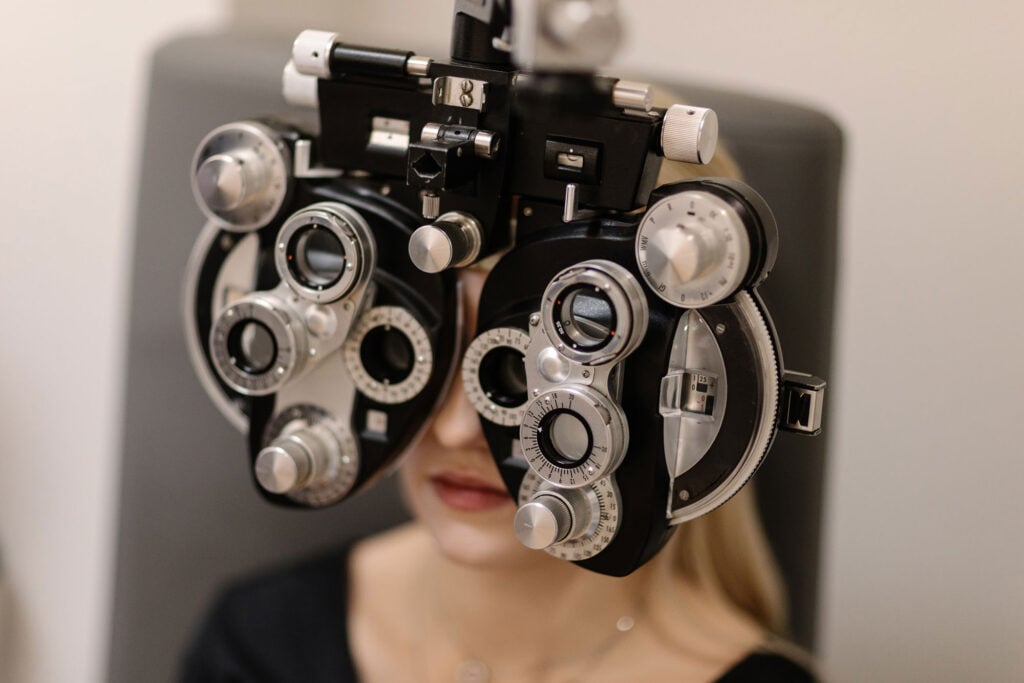
In the most common visual acuity test, an optometrist places an eye chart at a standard distance, twenty feet, or six metres, depending on the customary unit of measure. At this distance, the symbols on the line representing "normal" acuity on the eye chart, designated 20/20, is the smallest line that a person with normal acuity can read at a distance of twenty feet.
It is possible to see better than the norm, which optometrists express as visual acuity of "20/16" or "20/12.5", or better. For example, 97% of our short-sighted patients see "20/20" or better after surgery (which includes patients who see "20/16" or better, and patients who see "20/12.5" or better).
Three lines above, the letters have twice the dimensions of those on the "20/20" line. The chart is at a distance of twenty feet, but a person with normal acuity can read these letters at a distance of forty feet. This line is the ratio "20/40" (or "6/12"). If this is the smallest line a person can read, the person's acuity is "20/40," meaning, in a very rough kind of way, that this person needs to approach to a distance of twenty feet to read letters that a person with normal acuity could read at forty feet. For example, 100% of London Vision Clinic patients (-1.00D to -9.00D) see "20/32" or better, and 100% of patients (+1.00D to +6.00D) see "20/40" or better after laser eye surgery.
The biggest letter on an eye chart often represents acuity of "20/200", the value that is "legally blind." Many people with refractive errors have the misconception that they have "bad vision" because they "cannot even read the E at the top of the chart without my glasses." However, in most situations where acuity ratios are mentioned, they refer to best corrected acuity. Many people with moderate myopia "cannot read the E" without glasses, but have no problem reading the "20/20" line or "20/15" line with glasses. A legally blind person is one who cannot read the E even with the best possible glasses.
In laser eye surgery, the surgeon's goal is to get your vision without glasses after surgery to the same level as your "best corrected visual acuity" (with glasses or contact lenses) before surgery, or better. When optometrists or surgeons say "gaining or losing a line of vision", they mean the change in ability to read a line on the eye chart without glasses after surgery, from the ability to read the line with glasses, before surgery.
If you have more questions about your vision, contact a Patient Care Coordinator on 0800 587 4705 or email us.
Q. What is a prescription?
Optometrists and Ophthalmologists measure disorders of the eye, such as myopia, hyperopia, astigmatism, and Presbyopia in units called dioptres. These show the amount of correction you need to see normally. One dioptre is the equivalent of a lens that can focus on an object one metre away. The more short-sighted, long-sighted, or astigmatic you are, the higher your prescription in dioptres. A typical prescription has three numbers such as -5.00 / -1.50 x 180.
The first number (-5.00) identifies your degree of short-sightedness or long-sightedness. The minus sign in front of the number identifies you as short-sighted. A plus sign would show you were long-sighted.
The second number (-1.50) identifies your degree of astigmatism. This is written with either a plus sign or a minus sign.
The third number (180) indicates the axis, the direction of your astigmatism. An axis of 180 degrees, for example, means the astigmatism is horizontal.
A prescription of -5.00 /-1.50 x 180 indicates that the patient is moderately short-sighted, with a moderate degree of astigmatism in a horizontal direction.
The table below illustrates the ranges from mild to severe short-sightedness and mild to severe long-sightedness:
Mild short-sightedness |
Myopia up to -3.00 dioptres |
Low short-sightedness |
Myopia up to -3.25 to 6.00 dioptres |
Moderate short-sightedness |
Myopia from -6.25 to -11.00 dioptres |
Severe short-sightedness |
Myopia from -11.25 to -23.50 dioptres |
Low long-sightedness |
Hyperopia from +0.75 to +2.50 dioptres |
Moderate long-sightedness |
Hyperopia from +2.75 to +6.00 dioptres |
Severe long-sightedness |
Hyperopia from +6.25 to +12.00 dioptres |
If you have more questions about your prescription, contact a Patient Care Coordinator on 0800 587 4705 or email us today.
Q. Why can London Vision Clinic treat higher prescriptions than the norm?
Many patients will notice that London Vision Clinic is able to treat prescriptions that are higher than those commonly treatable with laser eye surgery in other clinics. One of our values is to be reassuringly rigorous, to do this; we spend a great deal of time with patients to conduct their preoperative screening.
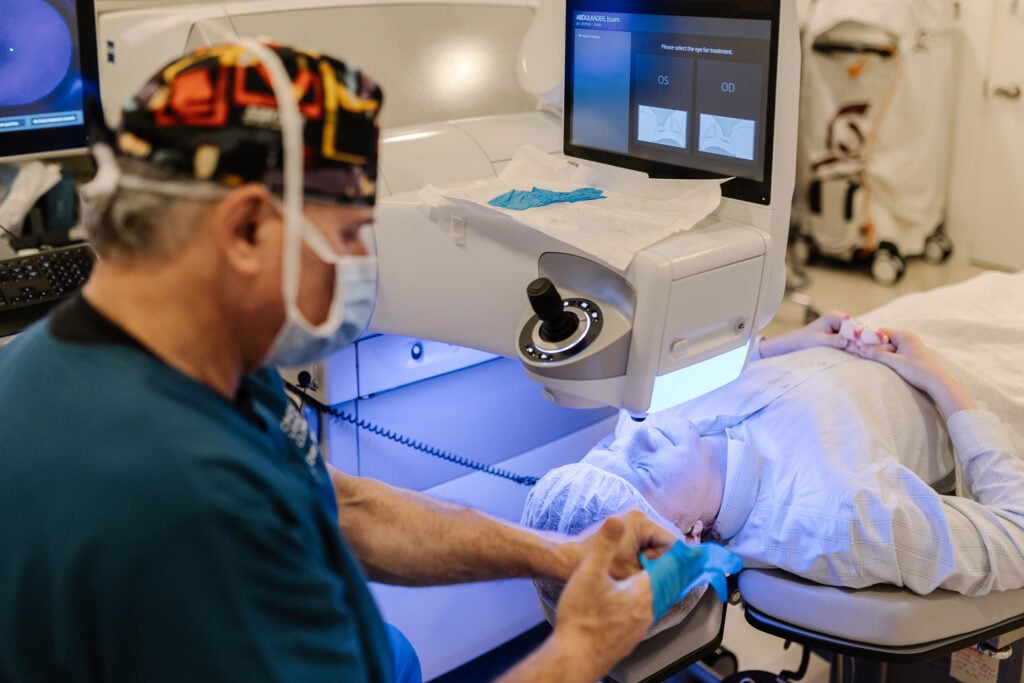
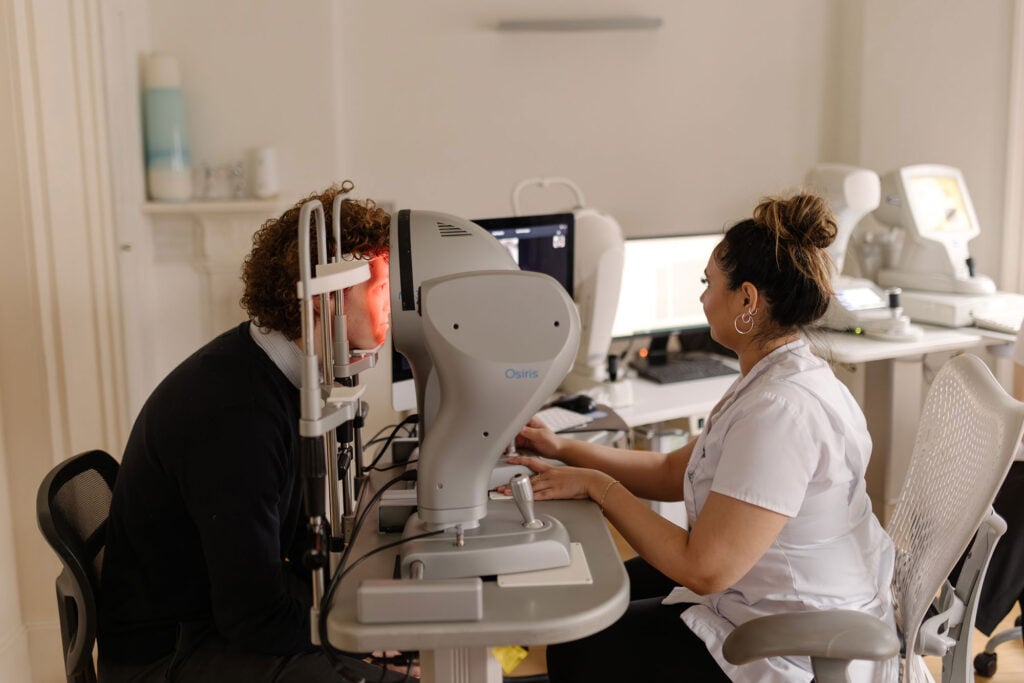
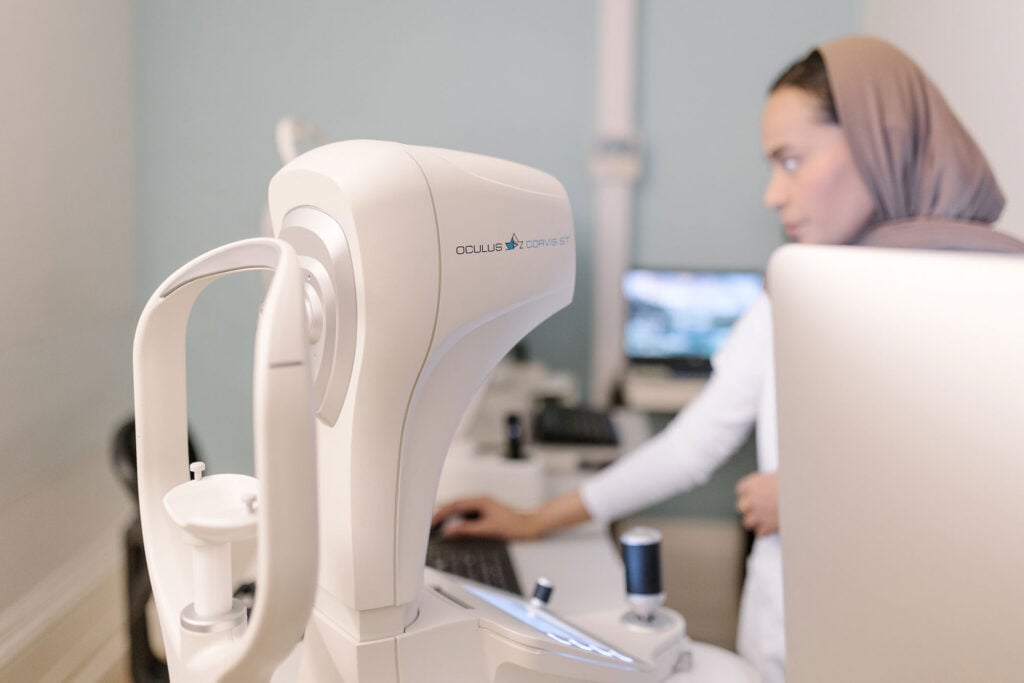
This extremely thorough evaluation is coupled with unique assessment technology (i.e. Artemis) that can assist us in approving cases that would be considered borderline at most clinics. Because we don't attract excessively large numbers of people to our clinic, we're able to spend as much time as necessary seeing one patient in the same amount of time it may take other clinics to see as much as four.
We further enhance our confidence by repeating many of the tests we do in extreme conditions (i.e. full darkness pupillometry, reduced light contrast sensitivity testing, dilated refractions). Again, all of this takes time, and if we needed to rush patients through a pipeline, we would not have the ability to perform all of these tests.
Employing a full-time research manager enables us to efficiently offer individualised treatment plans and enables us to help patients with unique needs (i.e. reading vision, High Profile procedures, wavefront-guided treatments to treat higher order aberrations). High street surgeons that have considerably higher volume quotas may prefer to treat the easier cases at a faster rate. The fact that many clinics remunerate surgeons on a per procedure basis aids to create an incentive to the treat more routine cases.
Having only Professor Reinstein and Mr. Carp perform surgery enables us to approve more patients for surgery. We do not have to worry about differences in levels of experience or expertise in our surgeons, and because either Mr. Carp or Professor Reinstein see every case before surgery, we can be confident that our screening net is sufficiently stringent. In addition, because accuracy decreases as -operative prescription increases, many clinics may want to keep their results high by treating easier cases. London Vision Clinic's results exceed the standard among all prescriptions; so again, we need not concern ourselves with tarnishing our results.
Lastly, because of our commitment to aftercare, we are happy to approve patients who may have a greater likelihood of needing an enhancement. Clinics know that individuals with higher pre-operative prescriptions have a greater chance of needing an enhancement. Because of this, many clinics will limit their exposure with these patients by refusing to treat them.
If you have more questions about your higher prescription, contact a Patient Care Coordinator on 0800 587 4705 or email us today.
Q. Do laser eye surgery results differ between prescriptions?
Yes. In general, results (the term used in refractive surgery is efficacy) decrease as prescriptions increase. Our experience at London Vision Clinic, while not as dramatic as the norm, mirrors this general trend. Therefore, when reviewing results, it is important to have these results reflect what vision patients achieve for specific prescriptions (as opposed to overall results across all prescriptions which are less relevant and are in fact often biased towards lower prescriptions).
One of the methods we use at mitigating this effect is by planning High Profile treatments with our patients who suffer from higher prescriptions.
High Profile treatments are akin to taking two attempts to reach a target instead of one. With one attempt, there is always the chance that we may overshoot or fall short of our target. Planning the treatment in two stages enables us to optimise safety and results for patients with higher prescriptions.
High Profile procedures cost more in terms of time and money, but the vast majority of our patients when presented with this option decide it is best for them.
Results also differ between short-sightedness and long-sightedness (i.e. 97% of short-sighted patients achieve "20/20" or better, while 90% of long-sighted patients achieve "20/20" or better). At London Vision Clinic, however, 100% of patients, short-sighted or long-sighted, with or without astigmatism achieve "20/40" or better. Indeed, 100% of short-sighted patients up to -9.00D saw "20/32" or better after treatment with at London Vision Clinic.
If you have more questions about laser eye surgery results, contact a Patient Care Coordinator on 0800 587 4705 or email us.
Q. Is there a higher chance of enhancements with higher prescriptions?
Yes, because accuracy decreases as prescriptions increase, we typically find that enhancements are more typical amongst patients who had higher pre-operative prescriptions, and among long-sighted patients. In spite of this effect, we still manage to keep our enhancement rates relatively low (between 5 and 8%).
If you have more questions about your chance of needing an enhancement, contact a Patient Care Coordinator on 0800 587 4705 or email us.
Q. Are laser eye surgery prices higher for higher prescriptions?
Many clinics charge people with higher prescriptions more than people with lower prescriptions. We consider this up selling. The reasons for this are clear - patients with higher pre-operative prescriptions have a higher likelihood of needing an enhancement, and they build the cost of this potential enhancement in to the total price at the outset (whether it's actually needed or not).
Our approach at London Vision Clinic is to offer patients with higher prescriptions the option of planned High Profile treatments. We have found that High Profile treatments have a higher likelihood of reaching the targets we have set out with the patient from the outset, and are a safer way to treat higher prescriptions. We charge higher fees for planned High Profile treatments. More information is available on our laser eye surgery prices.
If you have more questions about pricing, contact a Patient Care Coordinator on 0800 587 4705 or email us..
Q. Are there more risks associated with higher prescriptions?
Yes. The two areas where higher risks are associated with higher prescriptions are night vision disturbances (halos and starbursts) and corneal haze.
One of Professor Reinstein's main research focuses over the last 8 years has been the correction (and prevention) of night vision disturbances. Professor Reinstein has developed protocols for correcting and preventing halo and starburst effects even when treating very high prescriptions and patients with large pupils. Zeiss incorporates many of his findings in the commercially available Carl Zeiss Meditec MEL 80 excimer laser system, in use at the clinic today. It is therefore extremely rare for patients in our practice to end up with night vision disturbances. We confidently believe that we have the most sophisticated systems in place for preventing or treating night vision disturbances.
The risk of haze in PRK / LASEK increases the higher the prescription to be treated, but is also dependent on the smoothness of the surface created by the laser as well as the protocols for postoperative management of the cornea.
Corneal haze is part of the normal healing process in the corneal surface procedures (PRK / LASEK), and gradually subsides with little or no permanent effect on vision.
However, if the haze is excessive or does not go away, the patient may need additional treatment either with medications to reduce the haze or further laser surgery to physically remove the haze or both. Haze is extremely unusual in LASIK.
In about three in every 1,000 cases, patients develop astigmatism after surgery. Contact lenses can usually correct this form of astigmatism (glasses will not). People who have very high prescriptions have a higher risk of this complication. Astigmatism can happen even if the surgery is perfect, but an inexperienced surgeon or one who does not use the best equipment increases this risk.
There is more information about laser eye surgery risks. If you have more questions about risks, contact a Patient Care Coordinator consultant on 0800 587 4705 or email us.
Q. What is myopia (short-sightedness)?
Myopia, or short-sightedness, is a condition where the eye is too long and or the cornea is excessively curved resulting in too much focussing power. This means the image falls in front of the retina. You can see objects up close clearly but objects in the distance appear blurry. Laser eye surgery is ideally suited to treat short-sighted patients - (more)
Q. What is hyperopia (long-sightedness)?
Hyperopia, or long-sightedness, is a condition where the eye is too short or the cornea is not curved enough, resulting in too little focusing power. The image is focused behind the retina. Therefore, close objects appear blurry while objects in the distance are clear. London Vision Clinic results with long-sighted patients exceed the average results published in the medical literature - (read more)
Q. What is astigmatism?
Astigmatism occurs when your cornea is shaped like a football with two different curvatures. Images appear blurred or ghost-like because light rays are refracted unequally. In extreme cases, images both up close and for distance appear blurred. Many people who have myopia also have astigmatism. Astigmatism is treated using an oval laser beam, unlike myopia and hyperopia, which use circular beams. Laser eye surgery treats astigmatism - (more)
Q. Can laser eye surgery treat the loss of reading vision?
Yes. The loss of reading vision that is evident around the age of 45 is known as presbyopia or 'ageing eyes'. London Vision Clinic has been treating patients with presbyopia for years.
We call the technique used to correct presbyopia Laser Blended Vision. With this technique, one eye is treated to view objects mainly at distance, but a little up close, and the other is treated to view objects mainly up close, but a little at distance. The brain puts the two images together and enables the individual to see distance and near without effort. In most cases, the brain is able to compensate and you will experience an excellent depth of focus and overall visual acuity, without the need to wear glasses or contact lenses.
Q. What conditions might make one unsuitable for laser eye surgery?
Our laser eye surgeons are equipped to undertake some of the toughest laser eye surgery cases, however, there are still some people that they cannot treat.
Obviously, this can come as a disappointment to some patients who are extremely motivated to have their vision corrected.
Fortunately, for some, certain conditions are only a temporary barrier, and with our help, some of these patients do eventually qualify. The website contains a list of potentially disqualifying conditions that you can read about if you have any doubts as to your suitability. If you find that you have any of these conditions, you will want to tell your Patient Care Coordinator at your first phone call.
Q. What are the suitability differences between LASIK, LASEK, and PRK?
The vast majority of patients undergoing laser eye surgery worldwide are suitable for LASIK. Roughly, 10% of patients have LASEK or PRK. The main consideration when recommending LASEK or PRK over LASIK is corneal thickness. Secondary considerations include the patient's pre-operative prescription.
Find out if you are suitable for laser eye surgery now.