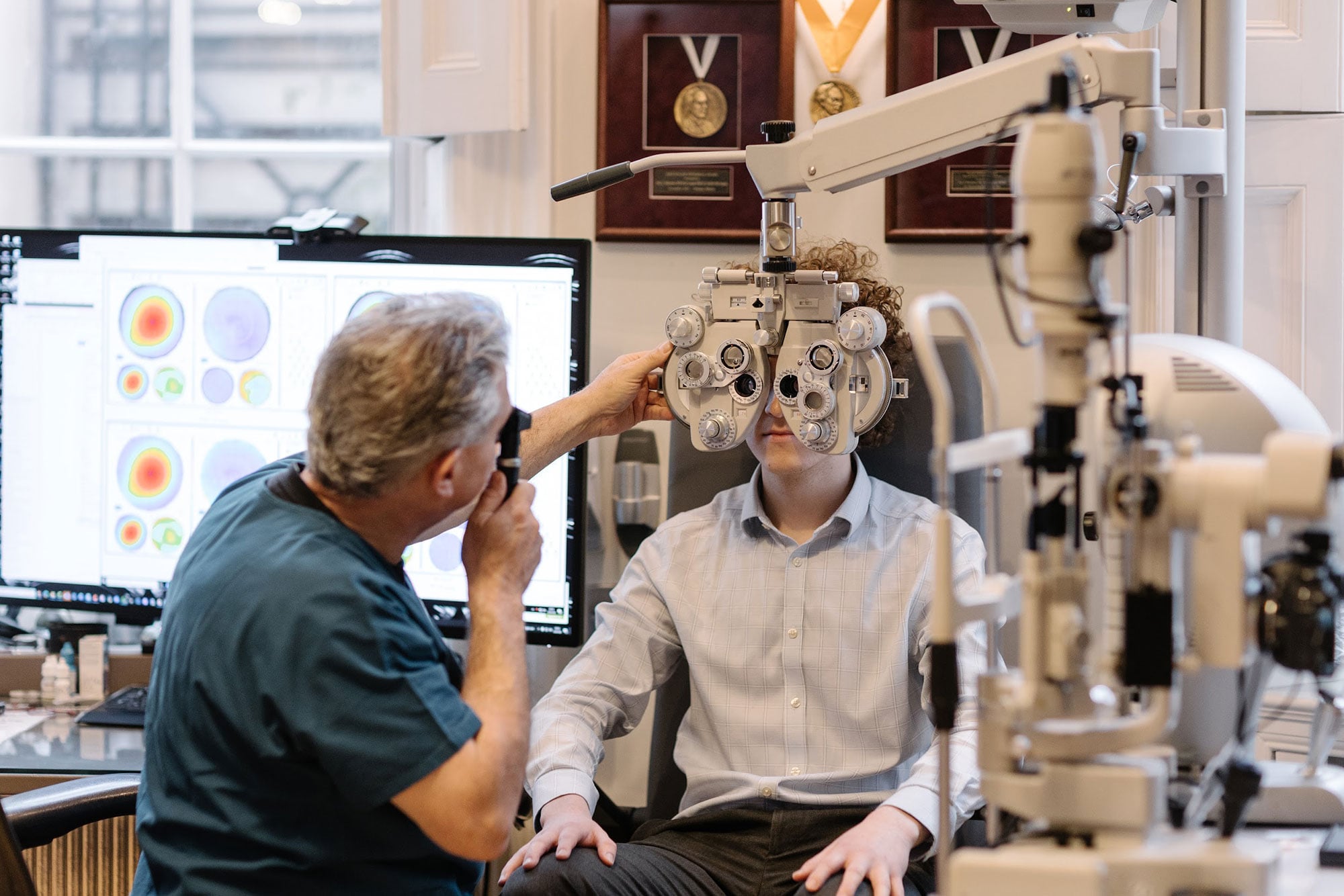
“Mr Carp describes the differences between LASIK and PRK / LASEK”
LASIK stands for laser in situ keratomileusis. It is the most popular form of laser eye surgery, in which the laser reshapes the cornea of the eye. LASIK treatment therefore alters the refractive properties of the cornea and thereby corrects or enhances eyesight.
LASIK eye treatment can correct of a full range of conditions, including myopia, hyperopia, presbyopia, and astigmatism.
In the UK, many clinics use other names to attempt to differentiate what is effectively the same procedure. These brand names include: UltraLASIK, UltraLASIKplus, Accu-wave LASIK, Custom LASIK, Wavefront LASIK, Zyoptix etc. Usually, these names represent the same treatment, guided by a wavefront aberrometer, and clinics usually offer it at a higher cost than conventional LASIK. In contrast, London Vision Clinic provides all of its patients LASIK guided by a wavefront aberrometer if they need it – without additional cost. In the interest of clarity, we just call it what it is, LASIK.
Recently, clinics have introduced the terms Femtosecond LASIK and IntraLASIK to the UK. This again is basic LASIK, however, instead of using the traditional microkeratome instrument to create the corneal flap, a surgeon uses a separate laser to cut the corneal flap. Femtosecond manufacturers often claim that the adoption of this laser can reduce complications and even improve accuracy. Femtosecond treatments are the standard at London Vision Clinic.
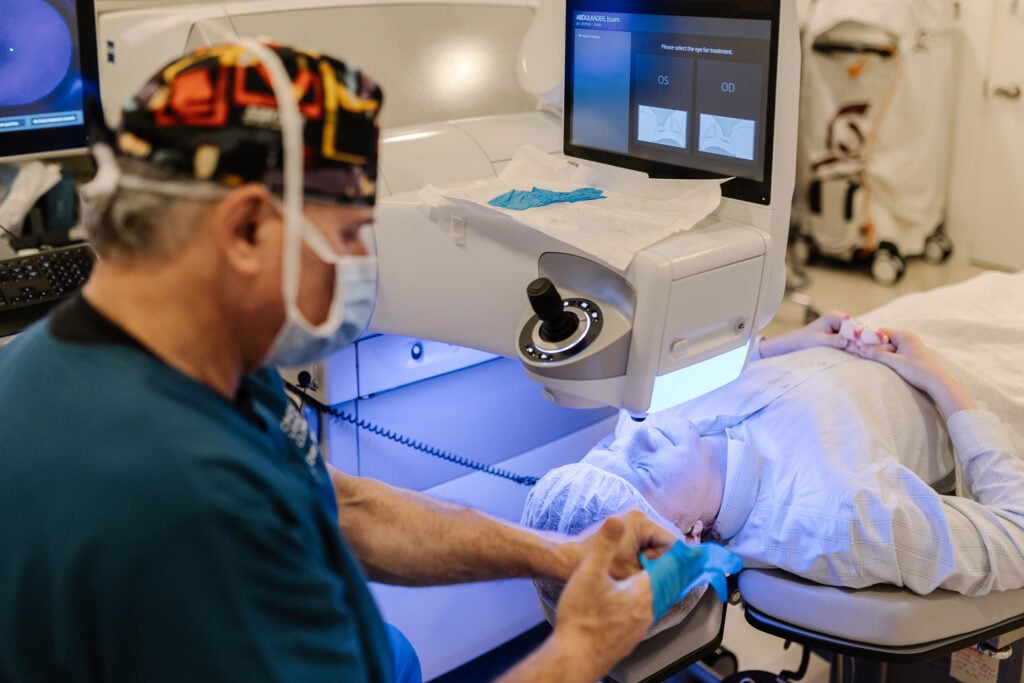
At London Vision Clinic, LASIK eye surgery consists of five steps:
Compared to PRK or LASEK, LASIK healing times are significantly shorter, with LASIK patients typically returning to work and leisure activities within two or three days of their LASIK treatment.
Vision improvement after LASIK eye surgery is virtually instantaneous, and it is perfectly safe and routine to treat both eyes using LASIK surgery on the same day.
Over 93 percent of LASIK patients meet the UK required standard for driving without glasses, although for some LASIK patients – particularly those with high prescriptions – glasses or contact lenses may still be required for some activities.
PRK or photo-refractive keratectomy was the first vision correction procedure to use excimer lasers and grew out of the pioneering scalpel-based refractive surgery.
In PRK eye treatment, no corneal flap is cut, instead the outer layer of cells from the surface of the cornea are removed entirely and subsequently grow back as part of the healing process.
After PRK, a surgeon places a soft contact lens over the eye to help the outer layer to grow back and this can take 3-5 days, during that period, the patient may experience discomfort and blurred vision. PRK takes longer to achieve a result than LASIK, but because the surgeon does not create or manipulate a corneal flap, it is technically easier to perform PRK than it is LASIK.
PRK eye surgery has successfully treated millions of patients since its introduction in the 1980′s
At London Vision Clinic, our laser eye surgeons typically use PRK in 5-10% of cases. The procedure is most suited to patients with unusually thin or flat corneas, which would make LASIK impractical.
PRK can correct of a full range of conditions, including myopia, hyperopia, presbyopia, and astigmatism.
Although the result achieved can be as good as those by either LASIK or LASEK, with PRK the surgeon mechanically removes the cornea’s surface and therefore discomfort and recovery times are significantly higher. Generally, vision will be good enough to drive a car within two to three weeks following surgery, but you may not achieve your best vision until 6 weeks to 3 months following PRK surgery.
In the UK, many clinics use other names to attempt to differentiate what is effectively the same procedure. These brand names include: UltraLASEK, UltraLASEKplus, EPI-LASEK, etc. Usually, these names represent the same treatment, guided by a wavefront aberrometer, and clinics usually provide these treatments at a higher cost than conventional LASEK or PRK. In contrast, London Vision Clinic provides all of its patients PRK or LASEK guided by a wavefront aberrometer if they need it – without additional cost. In the interest of clarity, we just call it what it is, PRK or LASEK.
Laser epithelial keratomileusis (LASEK) is a relatively new procedure and similar to LASIK, except with LASEK a corneal flap cut is from the protective tissue layer over the eye (the epithelium) and not the cornea beneath. As this corneal flap is very thin, the surgeon must loosen it with an alcohol solution before it they can lift it.
In all other aspects LASEK is identical to LASIK and follows the same broad steps:
The laser eye procedure to correct presbyopia or ‘ageing eyes’ involves a technique called Laser Blended Vision. The technique can be employed using either LASIK or PRK; whichever is most appropriate for the patient.
With this technique, one eye is treated to view objects mainly at distance, but a little up close, and the other is treated to view objects mainly up close, but a little at distance. The brain puts the two images together and enables the individual to see distance and near without effort. In most cases, the brain is able to compensate and you will experience an excellent depth of focus and overall visual acuity, without the need to wear glasses or contact lenses.
Laser Blended Vision is not to be confused with traditional monovision – a practice in which the contact lenses are set with one eye for near and one eye for distance. The difference with the Laser Blended Vision technique is that the Laser Blended Vision near eye sees much better at distance than the near eye set with traditional monovision, similarly the Laser Blended Vision distance eye sees more up close than the distance eye with traditional monovision. Because Laser Blended Vision is milder than monovision, far more people are able to adapt to it than to monovision. Approximately 95% of people are candidates for Laser Blended Vision as compared to about 50% for traditional monovision.
Unlike other techniques, intra-ocular lens (often referred to as IOLs, phakic IOLs, implantable lenses, clear lens extraction or exchange (CLE), intra corneal lens implants, STAAR® ICL, Artisan® lenses, Prelex® lenses, RLR, lens replacement surgery) use an artificial lens that is implanted into the cornea during surgery. The lens is permanent (but can be surgically removed), needs no maintenance and can remain in the eye for the patients entire life.
To preserve the focusing ability needed for reading, the surgeon does not remove the eye’s existing lens, but implants the intraocular lens, sometimes referred to as an implantable contact lens, in front of it and therefore assists vision much as a conventional contact lens would.
To implant the intra-ocular lens, the surgeon makes a small incision in the cornea and inserts a lens through this opening, positioned exactly in front of the pupil and fixed to the iris with two surgical clips. The incision is then closed.
Because the artificial lens has an enormous range, intra-ocular lens treatment is suitable for those patients with extremely high prescriptions. Indeed, in some cases it may be the only practical refractive surgery.
The great advantage of using an intra-ocular lens is the ability to treat conditions that would otherwise be impossible to correct without glasses.
However, with intra-ocular lens, the surgeon usually only treats the second eye once the first eye has healed, and this means a delay of two to three weeks between operations. After intra-ocular lens treatment, the lens restores vision almost immediately but is not at its best until approximately three weeks after intra-ocular lens surgery is complete.
In Keratoconus astigmatism, a serious form of astigmatism, the cornea progressively thins towards its edges causing a cone-like bulge to develop and resulting in significant astigmatic impairment. In the early stages it is possible to treat keratoconus with glasses or contact lenses, however, as the keratoconic disorder progresses and the cornea continues to thin and change shape, this solution becomes less and less satisfactory.
Cross-linking is a non-surgical treatment for keratoconus that strengthens the cornea by increasing the strength of the natural ‘molecular anchors’ within corneal tissue. In normal eyes, it is these anchors that give the cornea strength and prevent it becoming cone-like.
It can be combined with Intacs® to flatten the keratoconus cone even further. Intacs® are clear inserts that reshape the natural cornea to correct vision following keratoconus, Intacs® are placed below the surface of the cornea and so cannot be felt or seen. Made from a material used safely in contact lenses and cataract surgery for over 50 years, they are exchangeable and removable.
The Cross-linking treatment stabilises the keratoconic condition and helps the Intacs® reverse any distortion that has already occurred.
Cross-linking is a proven, non-invasive procedure that strengthens the weak corneal structure in keratoconus. This method works by increasing collagen Cross-linking, which are the natural “anchors” within the cornea. These anchors are responsible for preventing the cornea from bulging out and becoming steep and irregular (which is the cause of keratoconus).
The treatment involves custom-made riboflavin eye drops which are applied to the cornea, these eye drops are then activated by a special light. Laboratory and clinical studies demonstrate that this procedure increases the amount of collagen Cross-linking in the cornea and strengthens the cornea. In published European studies, researchers proved the safety and effectiveness of such treatments in patients.
The collagen Cross-linking with riboflavin has its roots in dermatology. Doctors looking for a way to strengthen sagging skin realised that triggering collagen Cross-linking was the way to achieve this. Eye physicians in Germany who performed initial studies took the process one step further. They reported results of treatments done as long ago as 1998, so there is a good record of accomplishment for this procedure.
Cross-linking treatments can also be combined with Intacs® to flatten the keratoconus cone even more than with Intacs® alone. In these cases, Cross-linking treatments stabilise keratoconus from getting worse as well as help the Intacs® reverse the keratoconus steepening that had already occurred up to the time of the treatment. Cross-linking is also showing promise in stabilising patients after radial keratotomy (RK).
Intacs® prescription inserts are indicated for use in the correction of nearsightedness and astigmatism for patients with keratoconus, where contact lenses and glasses are no longer suitable.
If you are found suitable for the Intacs® procedure, the steps are:
Follow-up visits will be required to monitor the healing process and evaluate the visual benefits of the procedure. Even after a successful procedure, glasses or contacts still may be required to provide you with good vision.
Contact us with your laser eye questions today.