Despite us using them almost every waking second of the day, there is still a lot many of us don’t know about our eyes. In this context, there is an abundance of misconceptions about vision and what it takes to keep our eyes healthy. At best, these misconceptions can be funny and harmless, but sometimes they can pose a real threat to eye health.
It can be difficult to sort fact from fiction and legitimate health advice from sensationalist claims. So, in this article, we’re going to cover four of these common misconceptions about eye health to clear up some of these persistent fallacies.
| Common Eye Myth | The Reality |
|---|---|
| Poor vision only affects the eyes | Vision problems can cause headaches, fatigue and affect concentration, posture and overall wellbeing. |
| The sun is always bad for your eyes | Moderate time outdoors may support healthy eye development, though UV protection is still essential. |
| Eye exercises fix vision problems | Exercises may reduce eye strain but they do not correct refractive errors like myopia or astigmatism. |
| Age related eye problems cannot be prevented | Healthy lifestyle choices, regular eye exams and modern treatments can delay or treat many conditions. |
Expert insight: Many misconceptions about vision persist because eye health advice often circulates online without medical context. Speaking with an experienced ophthalmologist remains the best way to understand your personal eye health and treatment options.
1. Poor vision is just an eye problem
For those of us who have lived with vision problems, from myopia (short-sightedness) and hyperopia (long-sightedness) to astigmatism and cataracts, it’s easy to consider it simply an eye problem.
Visual aids, such as glasses and contact lenses, can make it easy to forget about your vision problems (at least some of the time); however, poor vision can impact many other aspects of our lives. They can impact our ability to learn, focus, work, navigate, and generally exist in the world.
But weak vision can also impact other parts of our bodies. For example, straining to see clearly through a refractive error can lead to muscle fatigue, both in the eyes and in the neck and shoulders, and cause painful headaches. And just as vision problems can be linked to effects in other parts of the body, our general health can also affect our eye health.
Conditions such as diabetes, high blood pressure, and vitamin deficiencies can all have a significant impact on our eyes. This really drives home the importance of taking care of our bodies to our greatest ability and ensuring we seek treatment to control any underlying health conditions.
2. The sun is bad for your eyes
We all know that UV rays from the sun can hurt our eyes. It’s why the sunglasses industry continues to grow – well, that and their fashion appeal. But with all this sun slander, it is easy to forget that sunshine and spending time in the great outdoors can also be beneficial for our eye health, at least when enjoyed in moderation.
Studies have demonstrated that spending more time outdoors- i.e., in vast, open spaces- allows our eyes to relax as they gaze out over the horizon can reduce the risk of developing short-sightedness! But more recent research suggests that this isn’t the only benefit.
Some researchers are now proposing that being outdoors can benefit our eyes through another mechanism: Light from the sun can stimulate dopamine release in the retina. This neurotransmitter, known as the reward chemical, may, in turn, promote healthy vision and eye development!
Of course, getting more sun isn’t always as easy as we might hope. Daylight may be limited during some times of the year, while some parts of the world are simply too hot or too cold to spend too much time outdoors. Moreover, between work, social commitments, and other distractions, many of us spend much of our time in enclosed, artificially lit indoor spaces.
But if you can even get a couple of hours outdoors – even on an overcast day – this may be enough to benefit your vision. Of course, that isn’t to say you should spend your time staring at the sun… It is important to always wear good-quality sunglasses with 100% UV ray protection when in direct sunlight.
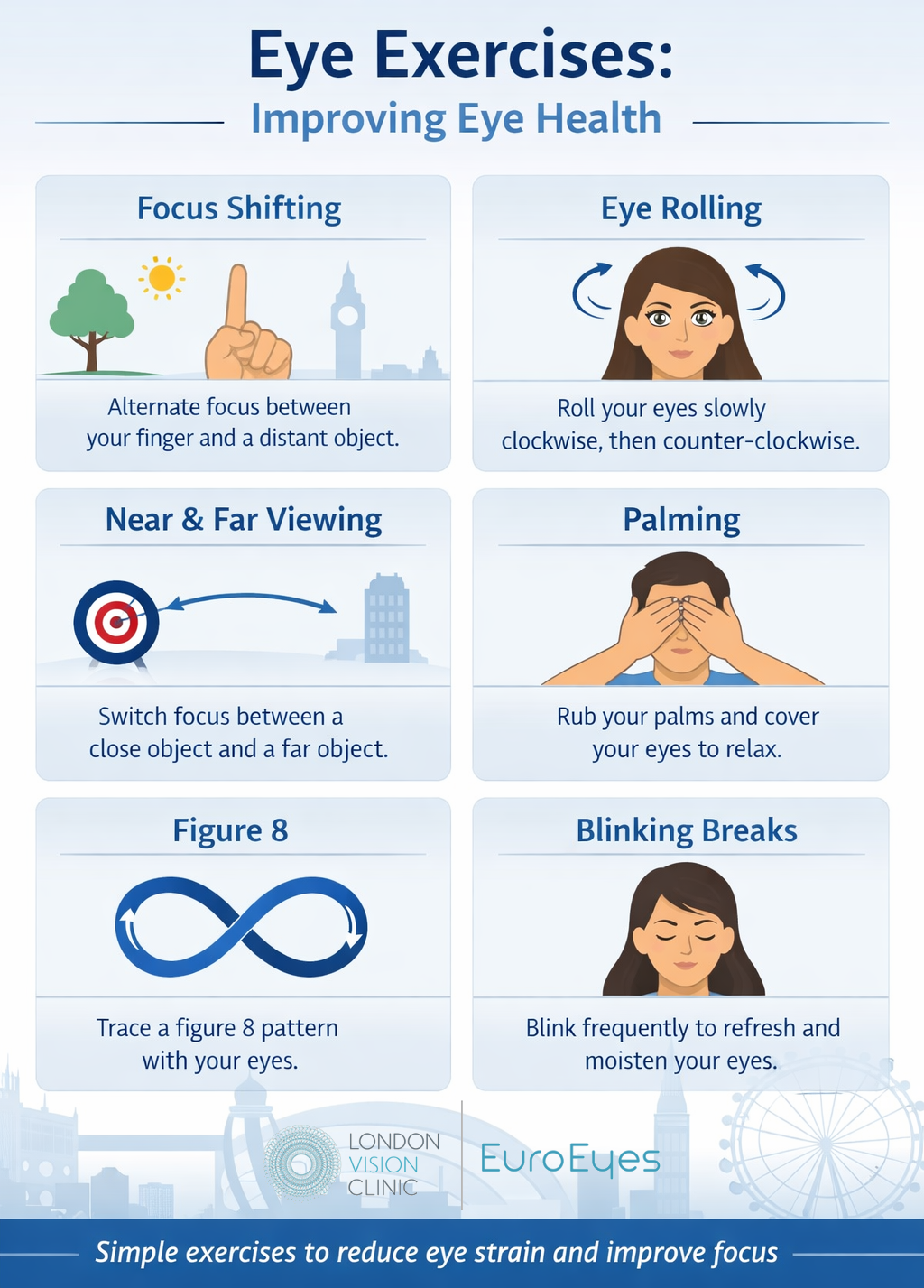
3. Eye exercises can improve all vision problems
Everybody is always on the lookout for simple tricks and habits that can help improve various aspects of our health. This might be committing to knocking out a set number of press-ups each morning, taking yourself for a nice stroll every evening, or simply eating better.
And when it comes to our eyes, you might think that performing a few “eye exercises” can improve their health. Unfortunately, this isn’t the case.
Of course, eye exercises, such as looking around in circles, can help to strengthen the muscles around our eyes. In turn, this may help relieve eye strain and fatigue, and in some cases, even help with certain binocular vision problems (such as diplopia). However, there is little evidence that eye exercises can improve refractive errors such as long-sightedness and short-sightedness.
4. You can’t prevent or delay common eye conditions
Many conditions can affect the quality of your vision as you age. Common problems such as glaucoma, cataracts, age-related macular degeneration, and presbyopia affect hundreds of millions of people around the world and can have a detrimental effect on vision.
Cataracts cause the clouding of the eyes’ lenses, presbyopia brings a reliance on reading glasses, and macular degeneration is the leading cause of blindness in the UK. But while many of these problems are considered a natural part of the eye’s ageing process, that isn’t to say there is nothing you can do to prevent or delay their onset.
We now know that many factors can play a role in the development of these problems, many of which can be addressed through lifestyle changes. For example, limiting our exposure to harmful UV rays, eating a balanced, eye-friendly diet, and spending more time outdoors may all help to delay the development of these sight-threatening problems!
And then there are effective treatments. Cataract surgery is now the most commonly performed procedure in the world and can restore up to 100% of vision that had been affected by cataracts. And when it comes to presbyopia, the innovative PRESBYOND® Laser Blended Vision treatment has helped tens of thousands of patients ditch their reading glasses for years to come!
Our eyes are closely connected to our overall health. In fact, many systemic conditions such as diabetes, high blood pressure and autoimmune disorders can first be detected during a routine eye examination. This is one reason ophthalmologists often describe the eye as a window into the body. Regular eye checks not only help protect vision but can also identify wider health concerns at an early stage.
Frequently Asked Questions About Eye Health
Can spending time outdoors improve eyesight?
Research suggests that spending time outdoors may help reduce the risk of developing short-sightedness in children and young adults. Natural light and focusing on distant objects may support healthy eye development.
Do eye exercises improve vision?
Eye exercises may help reduce eye strain or fatigue, particularly for people who spend long hours using screens. However, they do not correct refractive errors such as myopia or astigmatism.
How can I protect my eye health?
Protecting your eyes involves regular eye examinations, wearing sunglasses with UV protection, maintaining a balanced diet and managing health conditions such as diabetes or high blood pressure.
To find out if you’re eligible for a revolutionary laser eye treatment like PRESBYOND®, get in touch with one of our friendly clinic coordinators or Book a Consultation today!