If you’ve spent most of your life living with a refractive error, you have probably grown used to the various problems that come with wearing glasses or the daily irritation of your contact lens regime. But as you get older, you may also begin to notice that your reading vision is not what it once was. This might leave you switching between different pairs of glasses, wearing reading glasses over your contact lenses, or just simply going mad.
Luckily, there is an option that can correct vision across various fields – the varifocal lens.
What are Varifocals?
Like bifocal lenses and trifocal, varifocal lenses correct multiple prescriptions in a single lens; however, unlike these other lens types which have a clear line between distance, intermediate, and near, varifocals change from one prescription to another seamlessly. Specifically, varifocals offer a seamless transition from distance vision at the top of the lens through intermediate vision in the middle to near vision at the bottom.
The first iteration of the varifocal lens – which is also known as the Progressive Power Lens – is thought to have been conceived and patented in the early 20th century by British optometrist Owen Aves. However, they weren’t made commercially available until the late 1950s.
As manufacturing processes developed with the introduction of computer-aided design in the 1970s, varifocals became increasingly accessible to more people – and they have remained a popular choice today. But why might you need to correct your vision across various distances?
Why do you need Varifocals?
As we get older, most of us will eventually begin to notice a deterioration in our vision. This process, which is known as presbyopia or “ageing eye” occurs when the focusing power of the eye begins to weaken. As a result, your near vision will begin to worsen, making it increasingly difficult to perform close-up tasks such as reading.
While some people may find that reading glasses are a sufficient solution to their new refractive error, this may not be the case if you have an existing error. This is multi-prescription lenses like bifocals, trifocals, and varifocals come in.
But not everyone will see varifocals as the answer to their vision woes. In fact, while many people will get used to the various fields of vision offered by varifocals within a few weeks of wearing their new lenses, some may find this difficult to tolerate. Luckily, there is another option: PRESBYOND® Laser Blended Vision
Escaping Varifocals with Laser Eye Surgery
At London Vision Clinic, we have been pioneering laser treatment for presbyopia since 2004, when we became the first clinic in the UK to offerPRESBYOND® Laser Blended Vision, an innovative new treatment for presbyopia.
In the video below, our patient, Ken, and our expert Laser Eye Surgeon, Mr Glenn Carp, tell us more about PRESBYOND® Laser Blended Vision and how it works.
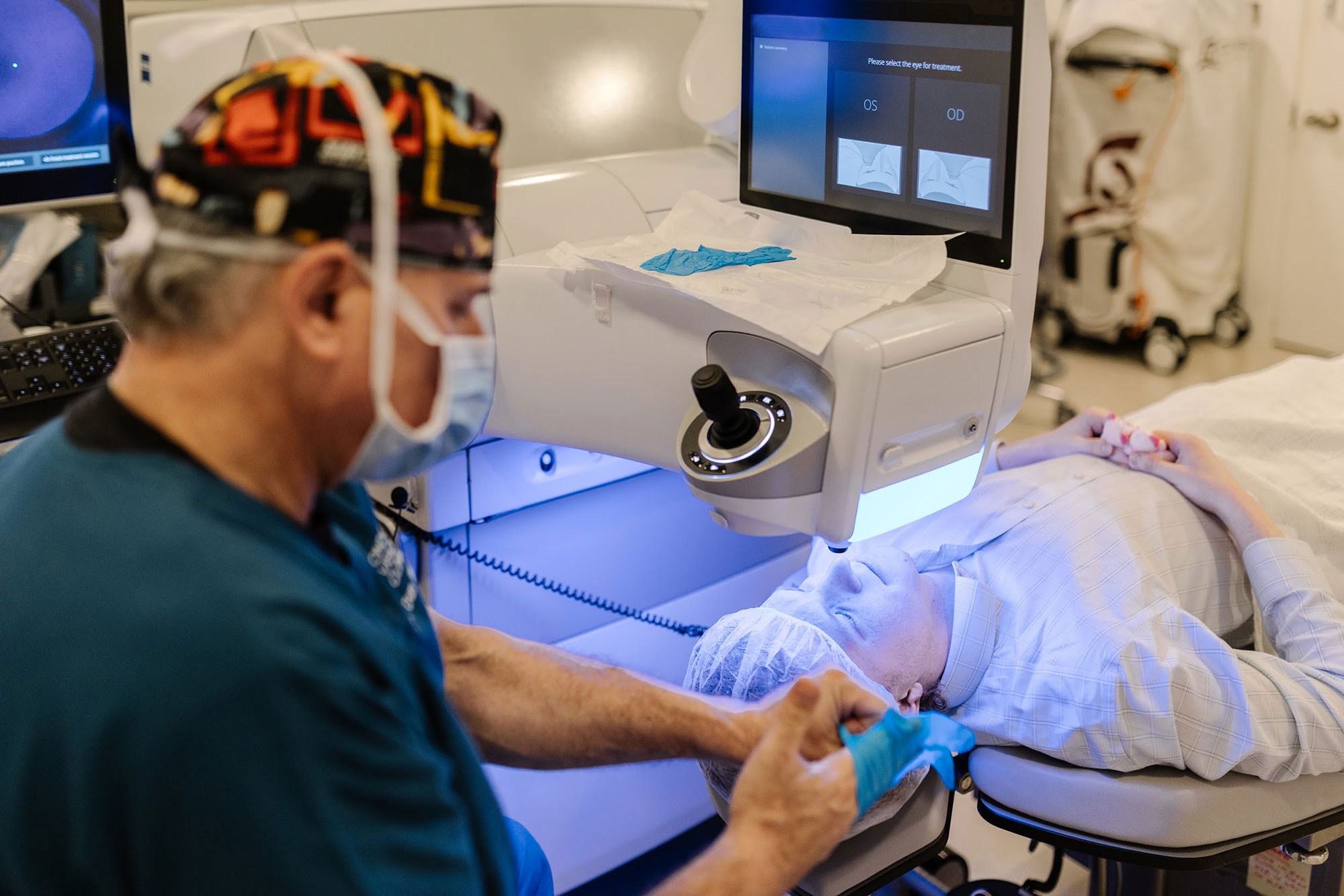
As Mr Carp explains in the video above, PRESBYOND® Laser Blended Vision adopts conventional Laser Eye Surgery techniques to provide clarity across all fields of vision. This is achieved by correcting one eye mostly for distance vision and a little for near, while the other is corrected mostly for near vision and a little for distance.
Amazingly, your brain is then able to combine the two images received from the eyes to create a clear picture across near, intermediate, and distance. What’s more, PRESBYOND® Laser Blended Vision is more tolerated than other treatments for presbyopia. For example, while only around 60% of patients will tolerate monovision, PRESBYOND® Laser Blended Vision is suitable for 97% of patients!
For most patients, this means they can throw away those infuriating varifocals.
To learn more about Laser Eye Surgery at London Vision Clinic or to find out if you could be suitable for PRESBYOND® Laser Blended Vision, get in touch with one of our friendly clinic coordinators or Book a Consultation today.