London Vision Clinic Foundation
Charity Initiatives and Partnerships
Too poor to see, can’t see to work, can’t see to survive…
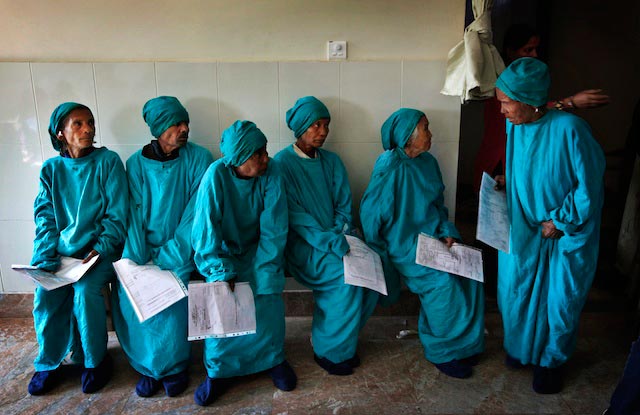
Thirty years ago, inventing a painless 10 minute procedure that heals in three hours and can eliminate dependence on glasses seemed like a pipe-dream. Today, laser eye surgery has made unaided vision a reality for millions of people. London Vision Clinic Foundation is a charity which has been established with the aim of using this extraordinary technology for the benefit of those who need it most. This humanitarian initiative aims to provide a solution for those people who are visually impaired simply because they lack the practical or financial means to have their vision corrected.
Shockingly, half of all treatable visual impairment and blindness in the developing world is due to the simplest of factors: uncorrected refractive error (short-sightedness, long-sightedness, astigmatism and presbyopia). In developing countries, more than two thirds of people who are visually impaired remain so simply because they are unable to afford a pair of glasses. This often results in them being unable to work, and therefore unable to support themselves or their families. Tragically, the life expectancy for someone who becomes blind in Nepal is less than three years. Nepalese society marginalizes and neglects the blind because of traditional beliefs that blindness is a curse or penance for sins in a previous life. Some even think blindness is contagious.
Although more than half a billion people remain visually impaired due to such preventable circumstances, proportionally little effort has so far gone into addressing this worldwide issue. This may be because – unlike cataracts, for example – visual impairment due to refractive error is not classified as an eye disease.
While, seemingly, the most obvious solution would be to improve distribution and affordability of spectacles, this has proven to be a difficult solution to implement in developing countries. For example, in Nepal, two-thirds of families live on less than $2 a day, and half the population live on $1.25 a day. And even when people are provided with glasses, they can last for less than a year, in the tough conditions in Nepal.
With the goal of employing laser technology to help combat this global problem, the London Vision Clinic Foundation has partnered with one of the leading humanitarian eye care organisations in the world: cureblindness.org and the Himalayan Cataract Project (HCP) (an initiative aimed at eliminating blindness resulting from cataracts and other treatable eye diseases). This partnership, at the Tilganga Institute of Ophthalmology in Nepal, is the first of its kind, and clearly has far-reaching humanitarian implications.
Dr Sanduk Ruit and Dr Geoff Tabin started the Himalayan Cataract Project with the aim of eradicating as much unnecessary blindness in their lifetimes as possible. They have proven that hospital quality standards can be applied in poor areas, even those lacking electricity and clean water. Their inventive approach and dogged perseverance made something that 20 years ago was considered impossible, possible.
The project with London Vision Clinic began in October 2009 when USAID’s Office of American Schools and Hospitals Abroad (ASHA) awarded a $700,000 grant to support renovation of the former Tilganga outpatient clinic. Professor Dan Reinstein was appointed as Director of Refractive Surgery on the Medical Advisory Board of Cureblindness.org; his unique expertise and experience as a leading authority in surgical training, research, and the systematization of high-volume, high quality laser refractive surgery fits perfectly with the underlying philosophy of the Himalayan Cataract Project: to eradicate preventable and curable blindness through high quality ophthalmic care, education and the establishment of a world-class eye care infrastructure that is financially self-sustaining through cost-recovery.
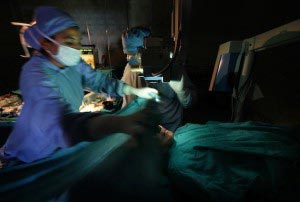
The London Vision Clinic Foundation, together with the generous help of the Georg and Emily von Opel Foundation, and a personal donation from Amer Al-Tajir and family, have sponsored the clinical training and purchasing of a surgical suite, which have made high quality laser refractive surgery at Tilganga possible. Tilganga’s Dr Kishore Pradhan, and the other staff of the new refractive surgery unit, were trained by London Vision Clinic, both on-site in Kathmandu, and here in London. The laser refractive suite is equipped with Carl Zeiss Meditec’sstate-of-the-art MEL90 and VisuMax lasers. NexTech – one of the leading electronic medical records providers – also donated their systems, so that the London Vision Clinic’s own protocols and templates could be directly implemented at Tilganga, and are now up and running.
Professor Dan Reinstein and Mr Glenn Carp both witnessed surgery beginning in Tilganga in January 2012, and Dr Kishore Pradhan has since been treating patients. London Vision Clinic Foundation operates with the aim of eliminating preventable visual impairment due to refractive error, and hopes to grow and develop in order to continue to provide those in the developing world with realistic access to the ground-breaking technology and professional expertise that now exists in the field of eye care.
London Vision Clinic Foundation is a registered charity: Reg. Charity No. 1122593