
FREE Consultation
Laser Blended Vision for Aging Eyes (Presbyopia) From London
Developed at London Vision Clinic, PRESBYOND® is a revolutionary treatment for aging eyes.
Eventually, the curse of aging eyes (presbyopia) comes for almost all of us, regardless of how good our eyesight was in our youth. With it, it inevitably brings its dreades reliance on reading glasses, which can be a shock to the system for those unused to external visual aids.
Why Choose London Vision Clinic For Presbyond Laser Eye Surgery?
PRESBYOND is not simply another vision correction treatment offered at London Vision Clinic. The clinic has played a central role in the development, refinement and clinical understanding of PRESBYOND Laser Blended Vision from its earliest stages, helping to shape the treatment used by surgeons around the world today. London Vision Clinic is internationally recognised for its research-led approach to refractive surgery and presbyopia correction. Its surgeons have published extensively on the science of binocular vision, developed patented diagnostic and treatment methods, and trained eye surgeons globally through specialist education programmes. This unique combination of innovation, experience and scientific leadership allows treatment to be tailored with exceptional precision to the visual needs of each individual patient.
| What's Included? Click each link for more information. |
London Vision Clinic
£3,950+
|
Mid-Market Clinics
From £2,000
|
Budget Providers
From £999
|
|---|---|---|---|
| Laser Eye Surgery Procedure | ✓ | ✓ | ✓ |
| Advanced Diagnostic Assessment | ✓ | Limited | ✕ |
| Personalised Treatment Planning | ✓ | Limited | ✕ |
| Research-Led Clinical Protocols | ✓ | ✕ | ✕ |
| Global Training & Education Leaders | ✓ | ✕ | ✕ |
| Published Scientific Outcomes | ✓ | Rarely | ✕ |
What You Say About London Vision Clinic
What is Presbyopia?
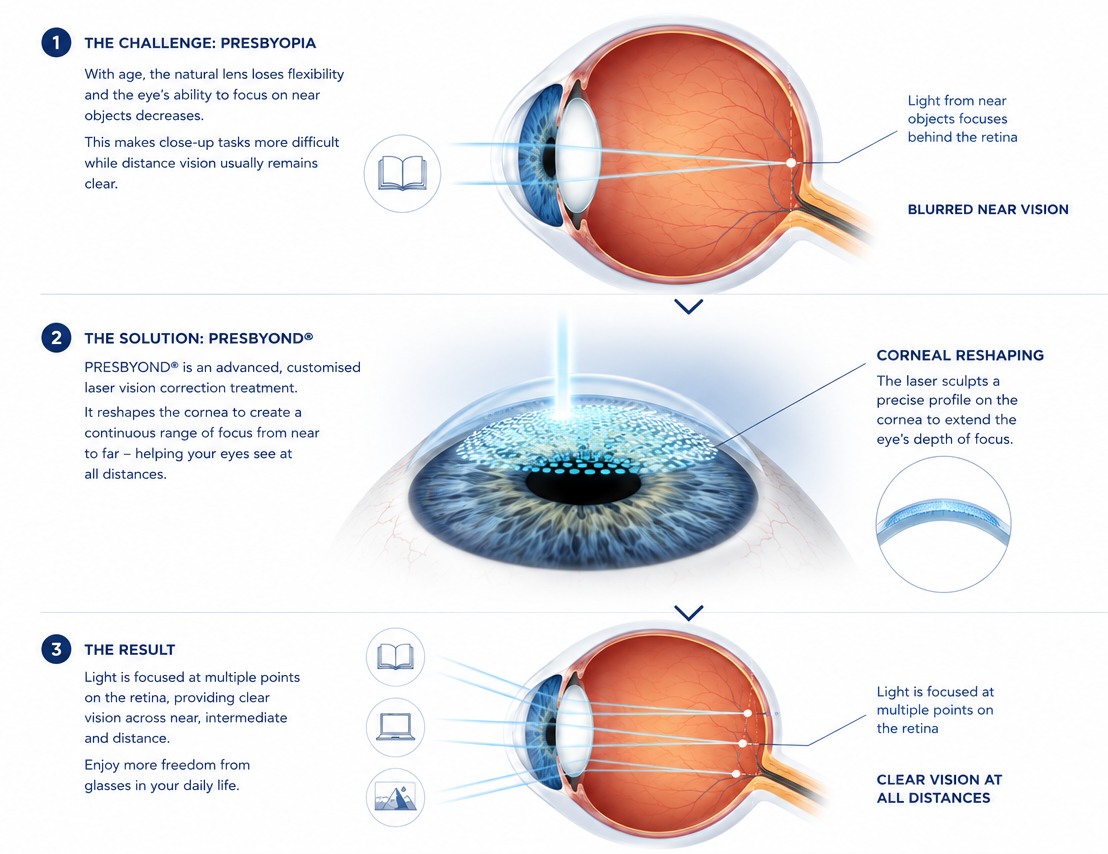
Presbyopia, from the Latin word meaning “old” or “aging eye”, is, for most of us, an inevitable part of getting older. That’s right, even our eyes are not immune from the effects of aging. As we reach middle age, the eyes’ natural crystalline lenses begin to lose their flexibility, affecting their ability to ‘zoom’ from near to distance vision.
Our diagram demonstrates one of the key changes that occurs as the eyes age. On the left, a younger, more flexible natural lens is able to adjust its shape and focus light accurately onto the retina, providing clear vision at close distances. On the right, the lens has become less flexible, a natural age-related process known as presbyopia, causing light from nearby objects to focus less effectively and making tasks such as reading a smartphone, book or computer screen more difficult. These changes typically develop gradually and are one of the most common reasons people begin to rely on reading glasses in their 40s and beyond.
How Does Laser Blended Vision Work?
PRESBYOND® Laser Blended Vision is a revolutionary treatment pioneered by our very own founder and expert surgeon, Professor Dan Reinstein. Having been implemented by Carl Zeiss into their state-of-the-art laser, the procedure can significantly reduce, or even eliminate, the need for reading glasses for many years to come. Moreover, it can be non-invasively adjusted should things change over time.
London Vision Clinic became the first Laser Eye Surgery clinic in the UK to offer this innovative treatment way back in 2009. Since then, it has helped thousands of patients ditch their reading glasses, bifocals, or varifocals!
Before the introduction of PRESBYOND® Laser Blended Vision, Laser Eye Surgery was simply unable to address the effects of aging eyes. To this day, many people believe that the only way to remove the need for reading glasses is through a more invasive procedure known as intraocular lens (IOL) surgery. However, this information is significantly out of date.
PRESBYOND® Laser Blended Vision adopts the basis of Laser Eye Surgery to counter the effects of ageing eyes. This is done by correcting one eye to see better at a distance and the other eye to see better close up. The brain can combine these two images in what is called the “blend zone”. As a result, you are able to see clearly across all distances!
An Innovative Solution to Presbyopia
PRESBYOND® Laser Blended Vision has major advantages over IOL implants for patients who do not require Cataract Surgery.
First of all, PRESBYOND® is a significantly less invasive procedure. This inevitably means that it is generally considered safer, with fewer risks of complications. Secondly, PRESBYOND® doesn’t require the same compromises as IOLs, where multifocal IOLs can affect the quality of your vision. Thirdly, the laser procedure tends to be more accurate than intraocular lenses and can be adjusted as the eyes continue to age.
Only around 30% of people in the UK require Cataract Surgery in their lifetimes. Still, if cataracts do develop and treatment is required, previous PRESBYOND® treatment provides even better reading potential after Cataract Surgery, even with standard IOLs used in NHS procedures.
Studies show that PRESBYOND® Laser Blended Vision is suitable for around 97% of patients with presbyopia. In contrast, only around 60% of people can tolerate classic monovision treatment (an alternative treatment that uses contact lenses or laser correction).
PRESBYOND® Laser Blended Vision has been adopted by Carl Zeiss Meditec and programmed into their lasers, so clinics worldwide can now offer this option. However, many Laser Eye Surgery clinics in the UK still rely on lens replacement surgery for correcting aging eyes.
Here at London Vision Clinic, we are proud to offer PRESBYOND® Laser Blended Vision, a far less invasive option that is suitable for the vast majority of patients.
PRESBYOND® Laser Blended Vision vs Monovision and IOLs
As mentioned above, PRESBYOND® Laser Blended Vision adjusts each eye in slightly different ways: one eye is adjusted to see mostly at a distance and a little close-up, while the other is the opposite: mostly up close and a little at a distance.
While it can take some time to adjust completely to this change, for the vast majority of people, the brain is able to combine these two images to provide a much greater depth of vision. The resulting improvement in all-around visual acuity means that most patients can finally throw away those infuriating reading glasses.
- Over 98% of PRESBYOND® Laser Blended Vision patients can read normal newsprint (‘N8’).
- Over 90% of PRESBYOND® Laser Blended Vision patients can read the small print on medicine bottle inserts.
What Does Professor Reinstein Say?
Monovision is a technique that also involves correcting each eye differently: one eye is corrected to focus on near objects while the other eye is focused on distance. This can be achieved with IOL implantation or with older laser systems. While monovision can be effective for some patients (around 60% are able to adapt), PRESBYOND® Laser Blended Vision is much more effective and easier to adapt to than monovision. Furthermore, PRESBYOND® Laser Blended Vision minimises many of the risks and compromises of IOLs and monovision.
So, while we may not be able to prevent the effects of aging, PRESBYOND® Laser Blended Vision can help you to escape the prison of reading glasses for a while longer and it’s suitable for pretty much everyone! What’s more, it offers a safer and more comfortable alternative to older treatment options.
For patients who can’t achieve full correction with Laser Eye Surgery, Bioptics might be an option. This combines the lens’s power inside the eye with any residual refractive error corrected with Laser Eye Surgery.
On a patient with presbyopia, do you prefer to perform PRESBYOND® Laser Blended Vision or a Clear Lens Exchange with a multifocal implant? In our clinic, when the patient has a clear lens, we would always choose to perform PRESBYOND® Laser Blended Vision over Clear Lens Exchange. Although there are arguments to support removing the natural lens inside the eye as a preventative method for cataract formation, these are still outweighed by the safer, less invasive, and more accurate PRESBYOND® Laser Blended Vision procedure. There are also fewer side effects reported following PRESBYOND® Laser Blended Vision than multifocal IOLs.
Professor Reinstein
FAQs
What causes Presbyopia?
Presbyopia is a word that comes from the Greek for ‘old eye’. It is when the zoom lens which is inside the eye becomes unable to change the focus of the eye from distance to near.
How common is Presbyopia, and what age should you start being aware of it?
Every single human being eventually gets presbyopia. Most people start to notice in their 40’s.
What signs should you look out for?
The typical things that normal sighted people notice first is that even though the distance vision remains clear as it has been all their lives, now they are having to start to hold things further away to be able to see them up close.
Eventually the arm is just not long enough and they have to buy a pair of ‘readers’ from the pharmacy or the supermarket to be able to see up close.
If people are short-sighted to start with, they find that with their distance correction they cant zoom up close any more so need to take their glasses off to read because they are short sighted and therefore focused at close and not dependent on the zoom lens to do the focusing for near.
If people are long-sighted to start with, both distance and near are ok when younger, but the near vision starts to get blurry at an earlier age, even in the 30’s. This is because the zoom lens is being used just to see at distance and there isn’t enough power to get things to go in focus up close. So the near vision goes first and then eventually the distance also starts to get blurry so they need glasses for both distance and near.
What options are there for correcting Presbyopia?
The simplest option is to get ready-readers from the supermarket, but the healthiest option is to see an optician or optometrist to get the eyes checked thoroughly for glaucoma and other problems such as macular degeneration and at the same time get advice on reading glasses. For most people who see well all their lives this will be the first time they ever see an eyecare professional for an eye examination. The more traditional way of surgically correcting presbyopia (ageing eyes) is to remove the natural lens and get a permanent lens replacement with a bifocal or trifocal multifocal artificial plastic lens implanted inside the eye.
However, the most modern way of correcting presbyopia now is by a modified laser eye surgery technique called PRESBYOND Laser Blended Vision which is an improvement on the original standard LASIK laser eye surgery that is used for distance correction in younger people. PRESBYOND is different from standard LASIK and is a significant advance on lens replacement surgery because it is much less invasive and therefore safer, it is more accurate at achieving 20/20 at distance and near, it has fewer side effects and provides better night vision and it is adjustable and reversible as the eye ages, and PRESBYOND is even less expensive than lens replacement surgery.
Over 95% of people are suitable candidates for PRESBYOND LASIK and the procedure takes 10 minutes in both eyes, heals in a few hours and people are reading small print already the next morning. PERSBYOND is the ‘Star-Trek’ method of presbyopia correction, available already in the 21st century.