So, you’ve worn glasses or contact lenses to correct your refractive error for years, but now, as you get older, you’ve begun to notice a deterioration in your reading vision. Maybe you’re switching between your regular prescription glasses and some cheap readers from the supermarket, or maybe you’re wearing the readers over the top of your lenses. One thing is certain though – you’re getting tired of switching between visual aids. Enter the bifocal lens.
What are Bifocals?
Bifocal lenses have been around for hundreds of years with their invention largely being credited to Benjamin Franklin in the late 18th century; however, they may have originally been invented even earlier! Still, the founding father undoubtedly helped to popularise these innovative lenses, prompting one type of bifocal – the Franklin split – to be named after him.
Despite being over 200 years old, the bifocals remain extremely popular today. This type of lens was created to correct both distance vision and near (reading vision). The idea behind the bifocal is rather simple – it is essentially two lenses in one, with the top half of the lens correcting for distance vision and the bottom half for near vision.
In Benjamin Franklin’s day, this would have equated to two half lenses carefully glued together (known as an “Executive” bifocal), but today, things are a little different. Bifocals today feature a lens with a majority part, called the “carrier” used for distance, to which a smaller “segment” is bonded.
However, the two areas of correction don’t necessarily need to be for distance and near vision. For example, some bifocal lenses may feature a carrier lens for distance vision with a segment for intermediate vision. In some cases, patients may require correction across three distances – this is where the trifocal lenses come in.
Why do you need Bifocals?
Bifocals may become necessary when you require correction in two fields of vision. This is most commonly the case when you develop presbyopia – also known as “ageing eyes”. Presbyopia is a natural part of the eye’s ageing process – though that doesn’t make the problem any less irritating. It occurs when the muscles in the eye begin to weaken, lessening the focusing power of the lens. This is the dreaded moment you find yourself considering bifocals.
But there are alternatives to reading glasses and bifocals, such as ICL surgery and Laser Eye Surgery.
PRESBYOND® Laser Blended Vision
At London Vision Clinic, we have been pioneering laser treatment for presbyopia since 2004, when we became the first clinic in the UK to offerPRESBYOND® Laser Blended Vision.
This innovative technique was developed with the help of our founder, Professor Dan Reinstein to offer a more well-tolerated alternative – and it worked! Around 97% of patients can tolerate PRESBYOND® Laser Blended Vision compared with around 60% who are suitable for monovision treatment.
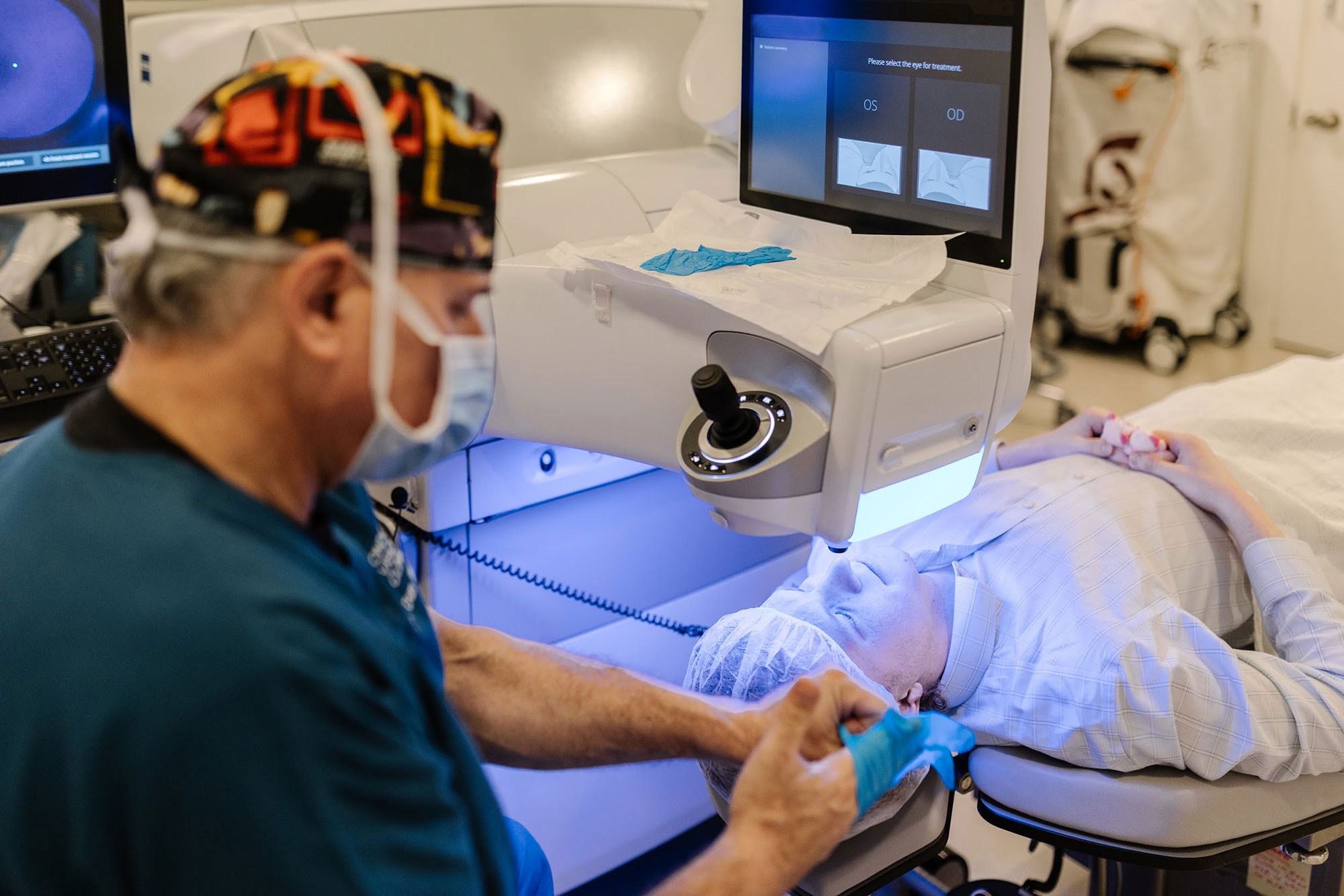
Using Laser technology, we adjust each eye in different ways: while one eye is corrected mainly for distance vision and a little for near vision, the other eye is corrected mainly for near vision and a little for distance. The brain is then able to combine the two images to deliver clear vision across all distances.
For most patients, this means they can throw away those infuriating bifocals or varifocals.
To learn more about Laser Eye Surgery at London Vision Clinic or to find out if you could be suitable for PRESBYOND® Laser Blended Vision, get in touch with one of our friendly clinic coordinators or Book a Consultation today.